Welfare and Value-Added Elasticities (WAVE)
(NOTE: this page is still in the process of being updated)
Assessing how global economic shocks spread across countries and sectors requires tools that capture both behavioral responses and structural interdependencies.
Trade models estimate welfare changes using substitution elasticities, but these are often externally calibrated and sometimes rely on strong assumptions such as homothetic and linear preferences. They tell us how trade flows might reallocate but not how these shifts propagate non-linearly through domestic and international production networks. Similarly, multi-region input-output (MRIO) models excel at describing supply-chain propagation, but usually rely on aggregate or approximated changes across intermediate and final demand often missing out on subtle treatments of the role of dependencies and substitutability across sectors.
These limitations have motivated the development of the Welfare and Value Added Elasticities (WAVE) model, which integrates flexible demand estimation with structural dependencies from MRIO linkagesto deliver a coherent and empirically grounded welfare analysis of structural shocks.
What the WAVE Model Does
The WAVE model combines a Quadratic Almost Ideal Demand System (QUAIDS) estimated using expenditure and price data (Naqvi, 2025) from the Asian Development Bank’s Multi-Regional Input–Output (ADB MRIO) database. These elasticities have been used for estimating direct and indirect impacts of 2025 tariffs shocks (Naqvi, 2025). This demand-system MRIO integration allows WAVE to estimate detailed behavioral responses at the country-sector level which can then be traced across global value chains to quantify changes in Value Added (VA), our key welfare metric.
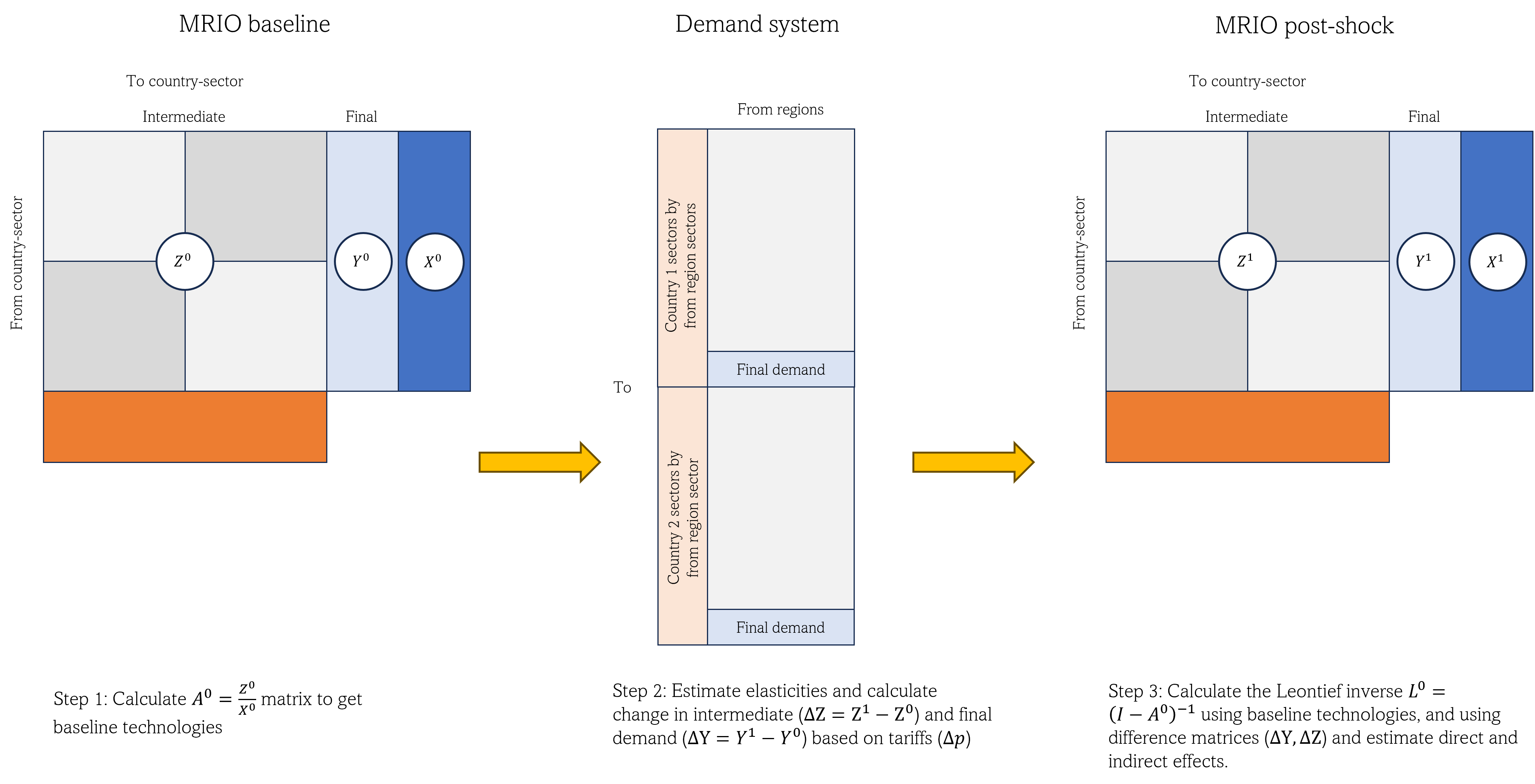
The figure above illustrates the framework of the WAVE model (Naqvi, 2025). The left panel shows the baseline Multi-Regional Input–Output (MRIO) system, consisting of three key components:
- \(𝑍^0\) is the intermediate transactions matrix, which captures how sectors across countries supply inputs to one another,
- \(𝑌^0\) is the final demand vector, which includes household, government, and investment expenditures, and
- \(𝑋^0\) is the resulting total output vector, determined by production technologies and final demand.
Value added is shown as the orange block beneath the IO structure, representing primary factor income generated by each sector. Baseline technical coefficients are extracted as \(A^0 = Z^0/X^0\) in the first step.
The centre panel represents the behavioral adjustment stage. Income and uncompensated price elasticities are extracted using the Quadratic Almost Ideal Demand System (QUAIDS) (Naqvi, 2025). Tariffs are then taken as an external shock to prices, and non-linear response to demand is computed for the intermediate ($\Delta Z$) and final demand ($\Delta Y$) matrices.
The right panel shows the full MRIO propagation of these behavioral changes. Once the intermediate and final demand vectors are updated to $Z^1$ and $Y^1$ respectively, the MRIO framework is used to estimate the indirect impact of changes to these matrices (Naqvi, 2025). Because sectors depend on one another for intermediate inputs, even small changes generate cascading effects throughout the production network. These propagate both domestically and internationally, ultimately yielding a new vector of Value Added where the percentage from the baseline (\(1 - VA^0/VA^1\)) is our estimated welfare loss.
What makes WAVE different
WAVE differs fundamentally from traditional trade or IO models in several ways. First, it relies on empirically estimated elasticities derived directly from MRIO data at the country-sector level in a consistent framework, rather than stylized parameters taken from sparse or dated literature.
Second, by embedding these elasticities within the MRIO system, WAVE models the entire pass-through of shocks, from consumer substitution to global supply-chain propagation, offering a richer picture than either approach can provide alone.
Third, the framework can evaluates the impact on Value Added or GDP losses, allowing for a more macro policy-level analysis.
What WAVE can be used for
Although initially applied to tariff shocks, the WAVE framework has much broader potential. It can evaluate:
- Trade policies such as tariffs, quotas, reshoring, and supply-chain diversification.
- Climate and energy shocks, including carbon border adjustments and fossil-fuel price changes.
- Disaster and resilience scenarios, where supply constraints interact with behavioral adjustments.
- Macroeconomic transitions, including global demand shifts and structural realignments.
WAVE’s combination of behavioral responses and structural interdependence allows analysts to quantify which sectors and countries are most vulnerable, how shocks propagate, and where resilience can be strengthened. Furthermore, the model has been optimized for quick interpretation and analysis. Depending on the depth of elasticities, the model can be quickly recalibrated and provides ready-to-use results in 1-2 day timeframe for rapid assessments.
The model currently uses the ADB MRIO, which, at the time of writing this post, is the only large scale database that provides consistent real and nominal values from 2007-2023. The data is limited to 62 countries (mostly Asia, Europe, and North America) with one Rest of the World (RoW) aggregate. This limits the in depth analysis to the available countries but hopefully datasets with a larger coverage would be released in the future. The analysis can easily be done with other trade datasets (e.g. COMTRADE, BACI) to estimate elasticities that can feed into other models.
What we learned from the 2025 USA Tariffs
(Naqvi, 2025) applies the WAVE model to the U.S. tariffs introduced in September 2025. The analysis shows that global value added falls by roughly 0.52 percent, with indirect effects about twice as large as direct ones. Direct losses occur mainly in traded manufacturing, such as textiles, chemicals, and machinery, while the majority of global losses come from indirect contractions in services, including transport, telecommunications, finance, and public administration.
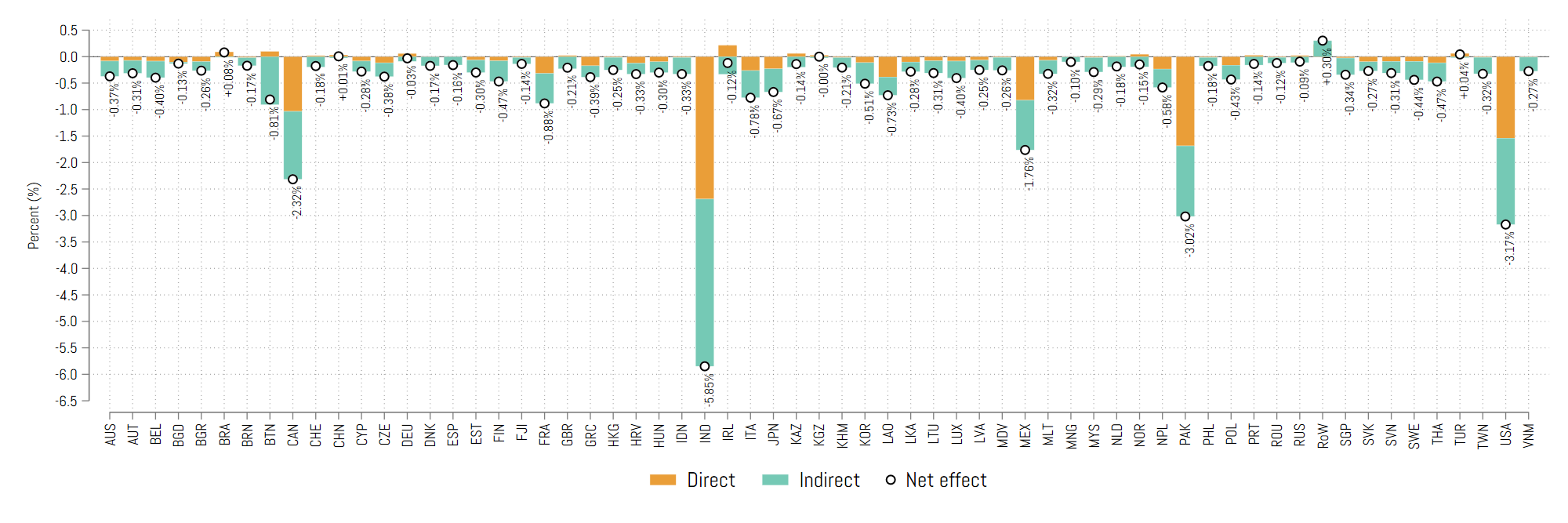
The figure above shows the headline result from (Naqvi, 2025), which decomposes the change in Value Added for every country in the data into direct effects, indirect effects, and the resulting net impact. The orange bars represent direct effects arising from reduced demand based on response to tariffs. The turquoise bars capture the much larger, economy-wide indirect consequences that emerge as these demand shifts propagate through global supply chains. The open circles denote the overall net effect, highlighting that for most countries, indirect propagation dominates the total outcome.
Several patterns stand out. First, direct effects are consistently small, typically between –0.1% and –0.5% in Value Added losses across most economies. These changes reflect the immediate response of traded manufacturing sectors (machinery, chemicals, textiles, and related industries) to the U.S. tariff increases. By themselves, these impacts would suggest only a modest global disruption.
The indirect effects, however, tell a very different story. For many economies, the turquoise bars extend far below the direct component, revealing how production linkages amplify and redistribute the shock. For example, India (IND) and Pakistan (PAK) experience value-added declines of approximately –5.85% and –3.02%, respectively, almost entirely driven by indirect effects originating from global supply-chain contractions. Smaller but highly open economies such as Ireland (IRL) and Mexico (MEX) also experience substantial indirect losses (around –1.7% to –2%), despite relatively limited direct exposure to U.S. tariffs. The figure also underscores that countries deeply embedded in global value chains, especially those with a higher dependence on a smaller number of countries, are the most vulnerable, not necessarily those directly targeted by policy measures.
The results for the United States and China further illustrate the systemic nature of the shock. The United States, the tariff-imposing country, shows approximately –3.17% net losses. In the figure, this outcome is driven overwhelmingly by the indirect bar, highlighting how tariff-induced price increases feed back into domestic production networks, raising costs for intermediate goods, compressing real demand, and reducing value added across service and infrastructure sectors. Meanwhile, China (CHN), a country that faced high tariffs, exhibits only a mild net effect (around –0.47%) with the figure showing a relatively small indirect response compared to other countries. China’s large domestic market and diversified supply structure dampen the propagation of the tariff shock, absorbing much of the initial disruption.
The way forward
The WAVE model provides the foundations for a broader research agenda.
The model can be used for a quick analysis of short- to medium-run income and/or price disruptions and how they cascade across countries and sectors. The results also be used as inputs to calibrate behavioral responses in macroeconomic models for an in-depth or a long-term analysis.
The model can be easily extended to incorporate the evaluation of other indicators. Adding employment rates by sector can support with the analysis of labor-market impacts, and indirect losses from demand-side multiplers. Linking environmental satellite accounts can allow for the analysis of emissions, resource use, and sustainability transitions.
As global disruptions become more frequent and complex, WAVE offers a scalable, empirically-grounded framework for understanding how shocks are likely to propagate, who is most affected, and where resilience can be strengthened across global supply chains.
Funding and support
The development of the WAVE model is part of, and funded by, the Austria Supply Chain Intelligence Institute (ASCII). ASCII is a multi-year joint collaboration between three institutes in Austria; the Complexity Science Hub (CSH), Austrian Institute of Economic Research (WIFO), and Logistikum FH Upper Austria.